Saving Normal : An Insider's Revolt Against Out-of-control Psychiatric Diagnosis, Dsm-5, Big Pharma, and the Medicalization of Ordinary Life (9780062229274) by Frances Allen
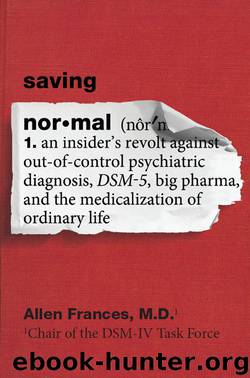
Author:Frances, Allen
Language: eng
Format: epub
Publisher: HarperCollins
Published: 2013-03-10T16:00:00+00:00
Post-Traumatic Stress Disorder: Hard to Get Right
Of all the many conditions in DSM-IV, post-traumatic stress disorder (PTSD) is paradoxically one of the most underdiagnosed and also one of the most overdiagnosed. Errors in both directions are common and easy to make; I know this well because I have made them both ways. PTSD is missed when people suffer its symptoms stoically and in silence. PTSD is overdiagnosed when it is a trigger for financial gain.
PTSD has probably been with us since the birth of humanity. Our ancestors were slow, weak creatures exposed and dreadfully vulnerable at the water hole. Life was always at risk, likely to be “nasty, brutish, and short.” Death lurked everywhere—unpredictable, sudden, and often violent. The human reaction to trauma is a great equalizer—regardless of all the differences in our personalities or previous life experiences, we all have the same set of remarkably uniform and stereotypical symptoms in response to a life-threatening stress. We relive the moment over and over and over again in a profoundly emotional way. Images, memories, or flashbacks bring it alive again, intruding incessantly during the day, and at night there are terrifying dreams. Anything resembling the event cues avoidance and terror. Every strange male face is a reminder of the rapist. A car backfiring is a reminder of being under rifle fire. Driving seems impossibly difficult after a bad car accident because the driver keeps visualizing the accident about to happen again. This set of reactions must have had enormous survival value—providing an absolutely indelible object lesson in the importance of avoiding similar dangers in the future. It was the ultimate in powerful one-trial learning—our ancestors had to learn fast and learn well because predators don’t often give second chances.
Almost everyone has at least some intrusive imagery and emotional reactivity to cues after a shocking event—this is part of the human condition and until recently was not defined as illness. For most people the intrusive images gradually become less intrusive and the triggers become less terrifying. The mental disorder PTSD should be diagnosed only when the symptoms persist and cause significant disability. At the severe extreme, PTSD can become chronic and incapacitating. Life is filled with haunting memories and scary triggers. It feels empty, stale, flat, and without meaning. The suicide rate is high.
What determines whether the reaction is transient enough to be considered normal versus devastating enough to be a mental disorder? A lot has to do with the nature and duration of the trauma. PTSD is more likely the more terrible the stress, the longer it lasts, the more intense and intimate the exposure, the more helpless the person feels. Someone who is shot is more at risk than someone who sees the shooting, and seeing is more risky that just hearing the shot at a distance. Horrors intentionally inflicted by humans—torture, rape, and assault—tend to cause worse symptoms than accidents or natural catastrophes. The course also depends on the person and his context. People who have had more emotional troubles before the trauma are more likely to have worse and more prolonged reactions to it.
Download
Saving Normal : An Insider's Revolt Against Out-of-control Psychiatric Diagnosis, Dsm-5, Big Pharma, and the Medicalization of Ordinary Life (9780062229274) by Frances Allen.epub
This site does not store any files on its server. We only index and link to content provided by other sites. Please contact the content providers to delete copyright contents if any and email us, we'll remove relevant links or contents immediately.
The Brazilian Economy since the Great Financial Crisis of 20072008 by Philip Arestis Carolina Troncoso Baltar & Daniela Magalhães Prates(334977)
International Integration of the Brazilian Economy by Elias C. Grivoyannis(111478)
The Art of Coaching by Elena Aguilar(53505)
Flexible Working by Dale Gemma;(23331)
How to Stop Living Paycheck to Paycheck by Avery Breyer(19800)
Thinking, Fast and Slow by Kahneman Daniel(12466)
The Acquirer's Multiple: How the Billionaire Contrarians of Deep Value Beat the Market by Tobias Carlisle(12400)
The Radium Girls by Kate Moore(12126)
The Art of Thinking Clearly by Rolf Dobelli(10652)
Hit Refresh by Satya Nadella(9216)
The Compound Effect by Darren Hardy(9104)
Tools of Titans by Timothy Ferriss(8535)
Atomic Habits: Tiny Changes, Remarkable Results by James Clear(8462)
Turbulence by E. J. Noyes(8153)
A Court of Wings and Ruin by Sarah J. Maas(8020)
Change Your Questions, Change Your Life by Marilee Adams(7885)
Nudge - Improving Decisions about Health, Wealth, and Happiness by Thaler Sunstein(7797)
How to Be a Bawse: A Guide to Conquering Life by Lilly Singh(7573)
Win Bigly by Scott Adams(7295)
